---
title: "RACI Matrix: Clarifying Roles and Accountability"
description: Discover how the RACI Matrix helps emerging leaders define roles, responsibilities, and accountability in projects—reducing confusion and improving team performance.
image: https://evolve2.au/hubfs/RACI%20Matrix%20Clarifying%20Roles%20and%20Accountability.png
---
- [Register Now](https://evolve2.au/find-a-course)
[.png?width=150&height=150&name=Evolve2%20Logo%20(Hi-Def).png "Evolve2 Logo (Hi-Def)")](https://evolve2.au/home)
- [Home](https://evolve2.au)
- About Our Courses
- [Evolve2 Leadership Program](https://evolve2.au/about-the-program)
- [Leaders & Managers](https://evolve2.au/leaders-managers)
- [Communication & Employee Engagement](https://evolve2.au/communication-employee-engagement)
- [Giving & Receiving Feedback](https://evolve2.au/giving-receiving-feedback)
- [Find a Course](https://evolve2.au/find-a-course)
- [Blog](https://evolve2.au/blog)
- [About Us](https://evolve2.au/about-us)
- [Contact Us](https://evolve2.au/contact-us)
[](https://evolve2.au/home)
close
- [Home](https://evolve2.au)
- About Our Courses
- [Evolve2 Leadership Program](https://evolve2.au/about-the-program)
- [Leaders & Managers](https://evolve2.au/leaders-managers)
- [Communication & Employee Engagement](https://evolve2.au/communication-employee-engagement)
- [Giving & Receiving Feedback](https://evolve2.au/giving-receiving-feedback)
- [Find a Course](https://evolve2.au/find-a-course)
- [Blog](https://evolve2.au/blog)
- [About Us](https://evolve2.au/about-us)
- [Contact Us](https://evolve2.au/contact-us)
# RACI Matrix: Clarifying Roles and Accountability
- [Home](https://evolve2.au/blog/home)
- [About us](https://evolve2.au/blog/home)
Leadership Tools
## RACI Matrix: Clarifying Roles and Accountability
- May 6 2026
- Evolve2 Toolbox
## What is a RACI Matrix?
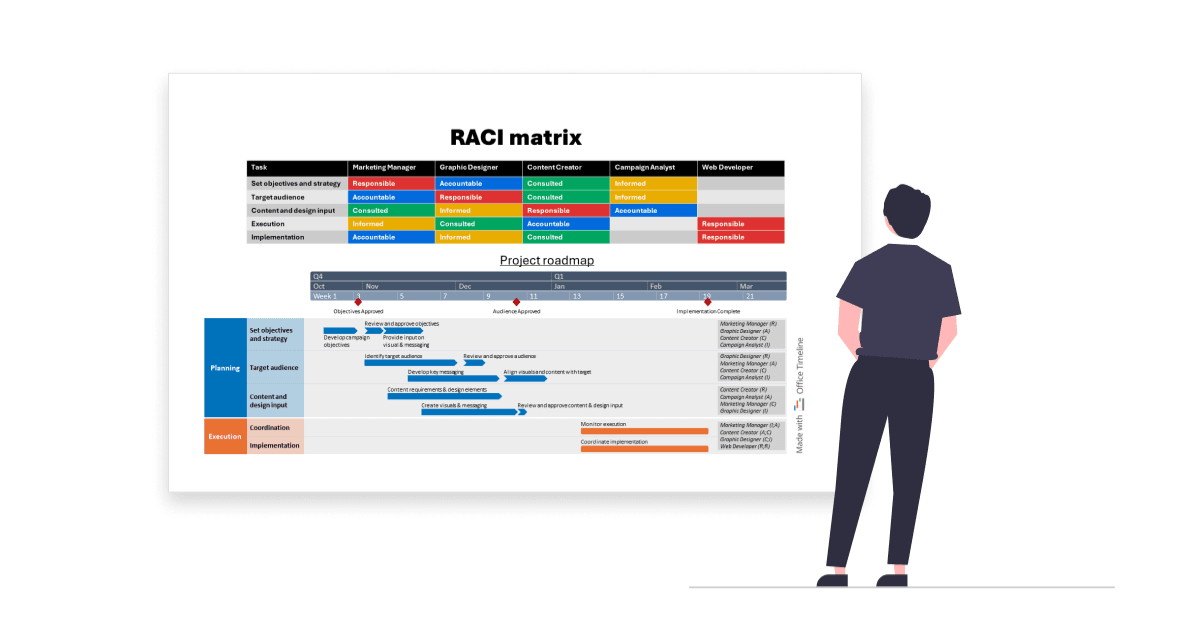
The **RACI Matrix** is a simple tool that clarifies who is **Responsible, Accountable, Consulted, and Informed** for each task or deliverable in a project or process. It prevents confusion, overlaps, and gaps in responsibility, ensuring everyone knows their role.
For emerging leaders, the RACI Matrix is especially useful for:
- Managing projects with multiple stakeholders.
- Avoiding duplicated effort or missed tasks.
- Setting clear expectations and accountability within teams.
---
## The Four Roles Explained
1. **Responsible (R)** – The person(s) who actually **do the work**. They complete the task and ensure deliverables are met.
2. **Accountable (A)** – The person **ultimately answerable** for the task’s success. Only one person should be accountable to avoid ambiguity.
3. **Consulted (C)** – Those whose **input is sought** before a decision or action. This is a two-way communication.
4. **Informed (I)** – Those who need to be **kept updated** on progress or outcomes. This is a one-way communication.
---
## Why RACI Matters
Projects often fail or experience delays because team members are unclear about responsibilities. A RACI Matrix helps by:
- Clearly defining who does what.
- Reducing duplicated effort or tasks being overlooked.
- Improving communication and stakeholder engagement.
- Making accountability transparent.
For example, in a product launch: the marketing lead may be **Responsible** for the campaign content, the project manager **Accountable**, the sales team **Consulted**, and the executive team **Informed**.
---
## Step-by-Step Guide to Using RACI
### 1. List Tasks or Deliverables
Start with a comprehensive list of tasks or project milestones. Be as detailed as necessary to ensure clarity.
**Example:**
- Create marketing campaign content
- Approve campaign design
- Distribute campaign to clients
- Collect and analyse engagement metrics
### 2. Identify Stakeholders
List all individuals or roles involved in the project. Include team members, managers, and external contributors if necessary.
**Example:**
- Marketing Lead
- Project Manager
- Sales Team
- Executive Sponsor
### 3. Assign RACI Roles
For each task, determine:
- **Responsible:** Who will execute the task?
- **Accountable:** Who is answerable for successful completion?
- **Consulted:** Who provides input or expertise?
- **Informed:** Who needs updates?
**Example Table:**
| Task | Marketing Lead | Project Manager | Sales Team | Executive Sponsor |
| --- | --- | --- | --- | --- |
| Create campaign content | R | A | C | I |
| Approve campaign design | C | A | I | I |
| Distribute campaign | R | A | C | I |
| Analyse engagement metrics | R | A | C | I |
### 4. Review and Communicate
Share the RACI Matrix with the team and confirm agreement. Address any overlaps, gaps, or ambiguity in roles.
**Tip:** Only one person should be Accountable per task to avoid confusion. Multiple Responsible roles are fine if clearly defined.
### 5. Monitor and Adjust
Use the RACI Matrix as a living document throughout the project. Update it if roles change or tasks evolve.
**Tip:** Keep it visible and accessible for the team, e.g., in a project management tool or shared document.
---
## Practical Tips for Emerging Leaders
- **Start Small:** Use RACI for critical projects before rolling it out team-wide.
- **Be Clear:** Avoid vague titles; specify roles explicitly.
- **Engage the Team:** Ensure stakeholders agree with their assignments to increase accountability.
- **Integrate with Workflow:** Use RACI alongside project plans, timelines, and regular status updates.
---
## Real-World Example
A new team leader, James, was overseeing a product launch. Tasks were being delayed because everyone assumed someone else was handling approvals. By creating a RACI Matrix:
- Responsibilities were clarified (Marketing Lead responsible for content).
- Accountability was explicit (Project Manager accountable for completion).
- Input was structured (Sales team consulted for client preferences).
- Updates were communicated (Executives informed at key milestones).
As a result, tasks were completed on time, communication improved, and the team avoided duplication or missed deliverables.
---
## Common Pitfalls
- **Too Many Accountable People:** Only one person should be accountable per task.
- **Ignoring Stakeholders:** Failing to include relevant consulted or informed parties reduces effectiveness.
- **Not Updating the Matrix:** Static RACI documents quickly lose value if roles or tasks change.
---
## Applying RACI in Leadership
Emerging leaders can use RACI to:
- Clarify roles in cross-functional projects.
- Improve team accountability and ownership.
- Avoid misunderstandings in complex workflows.
- Foster transparent communication between teams and stakeholders.
By systematically defining roles, leaders **reduce confusion, increase accountability, and ensure smoother project delivery**.
> The RACI Matrix is a practical tool that helps emerging leaders **clarify responsibilities, strengthen accountability, and improve team efficiency**. When implemented thoughtfully, it ensures everyone knows their role, reduces miscommunication, and enables projects to succeed on time and with confidence.
###### Tags:
[Leadership Tools](https://evolve2.au/blog/tag/leadership-tools)
###### Share on:
### Leave Your Comment Here
[](https://evolve2.au/home)
Empowering Tomorrow's Leaders, Today!
- PO Box 7241, Redland Bay, QLD, 4165
- Email: admin@evolve2.au
### Website Links
- [Home](https://evolve2.au)
- [About the Program](https://evolve2.au/about-the-program)
- [Find a Course](https://evolve2.au/find-a-course)
- [About Us](https://evolve2.au/about-us)
- [Contact Us](https://evolve2.au/contact-us)
### Our Partners
- [Industry Partners Australia](https://www.industrypartners.com.au/)
- [Efficiency Works](https://efficiencyworks.com.au/)
### Follow us on Socials
(c) 2024 All Rights Reserved.
[Privacy Policy](https://evolve2.au/privacy-policy) | [Disclaimer](https://evolve2.au/disclaimer)
```json
{
"@context" : "https://schema.org",
"@type" : "BlogPosting",
"author" : {
"@type" : "Person",
"name" : "Evolve2 Toolbox",
"url" : "https://evolve2.au/blog/author/evolve2-toolbox"
},
"dateModified" : "2026-05-06T22:30:00.506Z",
"datePublished" : "2026-05-06T22:30:00.000Z",
"headline" : "RACI Matrix: Clarifying Roles and Accountability",
"image" : [ "https://evolve2.au/hubfs/RACI%20Matrix%20Clarifying%20Roles%20and%20Accountability.png" ],
"mainEntityOfPage" : {
"@id" : "https://evolve2.au/blog/raci-matrix-clarifying-roles-and-accountability",
"@type" : "WebPage"
},
"publisher" : {
"@type" : "Organization",
"logo" : {
"@type" : "ImageObject",
"url" : "https://evolve2.au/hubfs/Logos/Evolve2%20Logo%20(Hi-Def).png"
},
"name" : "Evolve2 Pty Ltd"
}
}
```